
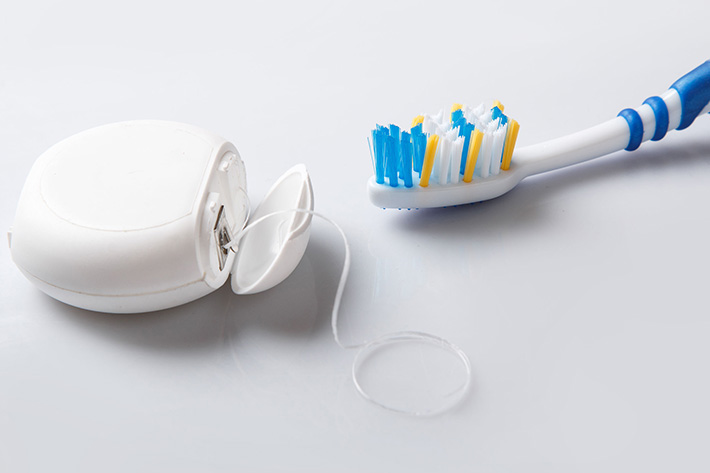
Daily, or twice daily tooth brushing, is a habit for a large number of Americans. Unfortunately, flossing of their teeth isn’t something most Americans do on a daily basis. Research suggests that less than 30 percent, and perhaps as little as 10 percent, of Americans floss on a daily basis.1 The Academy of General Dentistry maintains, however, that “flossing is the single most important weapon against plaque, perhaps more important than the toothbrush.”2 Knowledge of how cavities form and where cavities are most likely to form helps in understanding why daily flossing is so important to maintain good oral hygiene and prevent tooth decay.
Flossing your teeth can protect your overall dental health just as much, if not more than brushing.
So when both are done on a regular basis, it’s the armor your teeth and gums need for long term dental health. Keep reading to find out how both brushing and flossing works.
How Plaque Turns into Cavities
It may be surprising to know, but there are over 600 different species of bacteria in your mouth with over 100 million bacteria in every millilitre of saliva, but rest assured that most bacteria in your mouth is eventually killed by enzymes in saliva or the stomach.3 Some of that bacteria stays in your mouth and on your teeth as a sticky film which is called dental plaque. When plaque hardens it is called tartar.
When you have your teeth professionally cleaned by a dental hygienist they use tools to remove any dental plaque. If the plaque isn’t removed by brushing, flossing or a dental cleaning the plaque feeds on sugary foods and drinks and produces acid which starts to eat away at tooth surfaces. That’s how cavities form.
Minimizing Plaque
The most common places adults get cavities are where plaque gathers. This includes around the gum line, along the edges of existing fillings, in the ridges of the biting surfaces of teeth including the back molars and premolars, and where teeth connect.4 When a cavity forms between two teeth it is called an interproximal cavity. A toothbrush does a good job cleaning the tops and sides of your teeth. It doesn’t get between the teeth. If your teeth are too close together, a toothbrush won’t reach into the areas that touch. That’s why daily flossing is so important.
Technique matters to get the most from your daily flossing routine. Dental professionals are more than happy to demonstrate that correct way to floss. Take the time on your next visit to ask for a hands-on demonstration. There are some great www.YouTube.com videos that also show you how to floss correctly.
Flossing Tips
Basically, you should take 18 to 24 inches of dental floss and wind it around both of your middle fingers, leaving about 1-2 inches of floss in the middle. Hold the floss tight with your thumb and index fingers. Then glide the floss up and down between two teeth, rubbing it against both sides of each tooth several times. It’s important to get the base of each tooth. To do this, curve the floss at the base of the tooth to form a letter “C” shape. Use a clean section of floss as you move to the next set of teeth. Don’t pull the floss down hard against your gums as this will cause bleeding. The Academy of General Dentistry recommends flossing at least once per day for about two to three minutes.5
Dental Floss Options
Flossing requires a bit of manual dexterity. A pre-threaded flosser or floss holder can make the task easier. These floss holders generally have ergonomic handles, dental floss with a finish that makes slipping between teeth gentle and easy, and they are small enough to fit into a purse or bag. The new GUM® Dual Technique Flosser actually has two flossers, an F-shaped flosser head designed for the front teeth and another Y-shaped flosser head designed to better reach back teeth. Loaded with twisted and shred-resistant floss the manufacturer claims that this flosser covers 30 percent more surface area than the average single stranded floss.6
Dental professionals wouldn’t advocate skipping your daily tooth brushing and taking up flossing instead. They would advocate that you work toward daily flossing. The Academy of General Dentistry believes that “flossing even two or three times a week has its benefits and is far better than not flossing at all.” 7 The more you floss, the less likely you are to hear the bad news that you have a cavity that has to be filled.
Visit the Dentist
When you implement an oral hygiene routine it should include both brushing and flossing. Just doing one is not your best protection, the goal is to practice both and not rely on just brushing. Our dental clinic in Commerce Twp can help educate you on the importance of dental health and proper daily practices.
If you have dental concerns or are looking for a new dentist, look no further. For 20 years, Sedki Dentistry has been keeping mouths healthy and happy with the latest techniques, treatments, and technology available. Our services include cosmetic dentistry, restorative dental treatments, gum rejuvenation, children’s dentistry and so much more. Call and schedule a Free Dental Consultation with Dr. Sedki and see why he is a preferred dentist throughout the Lakes area and beyond!
___________________
1 How Many Americans Floss Their Teeth? by Steve Sternberg, 5/2/2016
Link: https://www.usnews.com/news/articles/2016-05-02/how-many-americans-floss-their-teeth
2, 5 Should I Floss?
Link: https://knowyourteeth.com/infobites/abc/article/?abc=F&iid=302&aid=1244
3 Mouth Bacteria: How Many Types of Bacteria are Found in the Mouth & How are they Related to Health?, 8/18/2009
Link: https://www.brighthub.com/science/genetics/articles/45935/
4 What is Tooth Decay? Cavity Symptoms, Causes, and Treatment Options by Dr. Catalina Botero, 5/17/2021
6 What is Tooth Decay? Cavity Symptoms, Causes, and Treatment Options by Dr. Catalina Botero, 5/17/2021
Link: https://www.gumbrand.com/interdental-cleaning/flossers/gum-flosser-dual-technique-mint-60ct.html
7 Facts About Flossing
Link: https://www.deltadentalins.com/oral_health/flossing3.html